
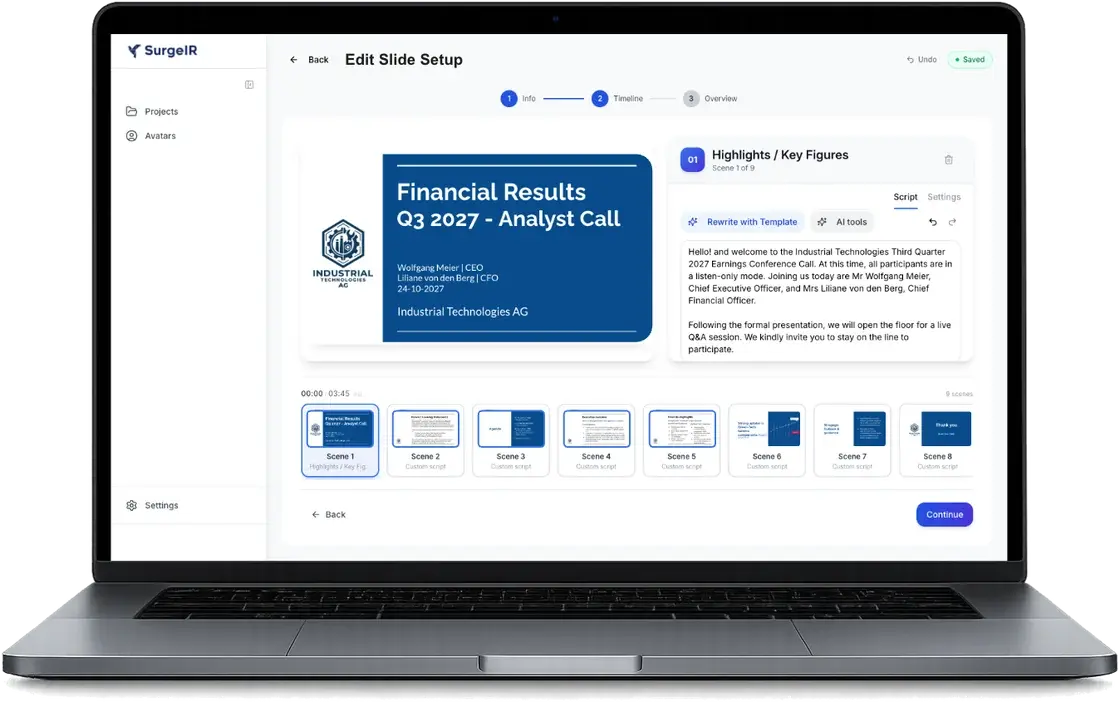
The SLIDE-LED PRESENTATION

Create more time for human interaction. For real conversations.

Your report, narrated over your slides — as guidance before the call, or as the call itself. No camera, no crew, and generated in minutes. Issuers use it two ways, and many end up using both.
Talk to us
THE FORMAT

Narrative Precision in Every Earnings Call

Executive-level investor presentations — slide-led financial messaging with fully scripted, checked, and vetted  narration, using the exact voice of your CEO or CFO.

download
ONE FORMAT • TWO USES

Executive-level investor updates — fast, compliant, and without production friction.

These are not two lengths of the same presentation. One is short and supplemental, published to steer the reading before anyone speaks. The other is the prepared remarks in full, taking the place of management reading the deck out loud on the call.

Supplemental

Guidance ahead of the call

Five or six minutes published with the release, hitting home the topics management believes the quarter turns on. It replaces nothing — the report stands, the deck stands, the call stands. What it decides is what gets read first, and it reaches the retail and international holders who were never going to dial in.

Substitute

The pre-recorded earnings call

The prepared remarks in full, narrated over the same slides and published with the release, so the live hour opens on questions rather than a twenty-minute reading. Same script, same sign-off, same delivery in every language your register reads — and no executive has to be word-perfect at seven in the morning.
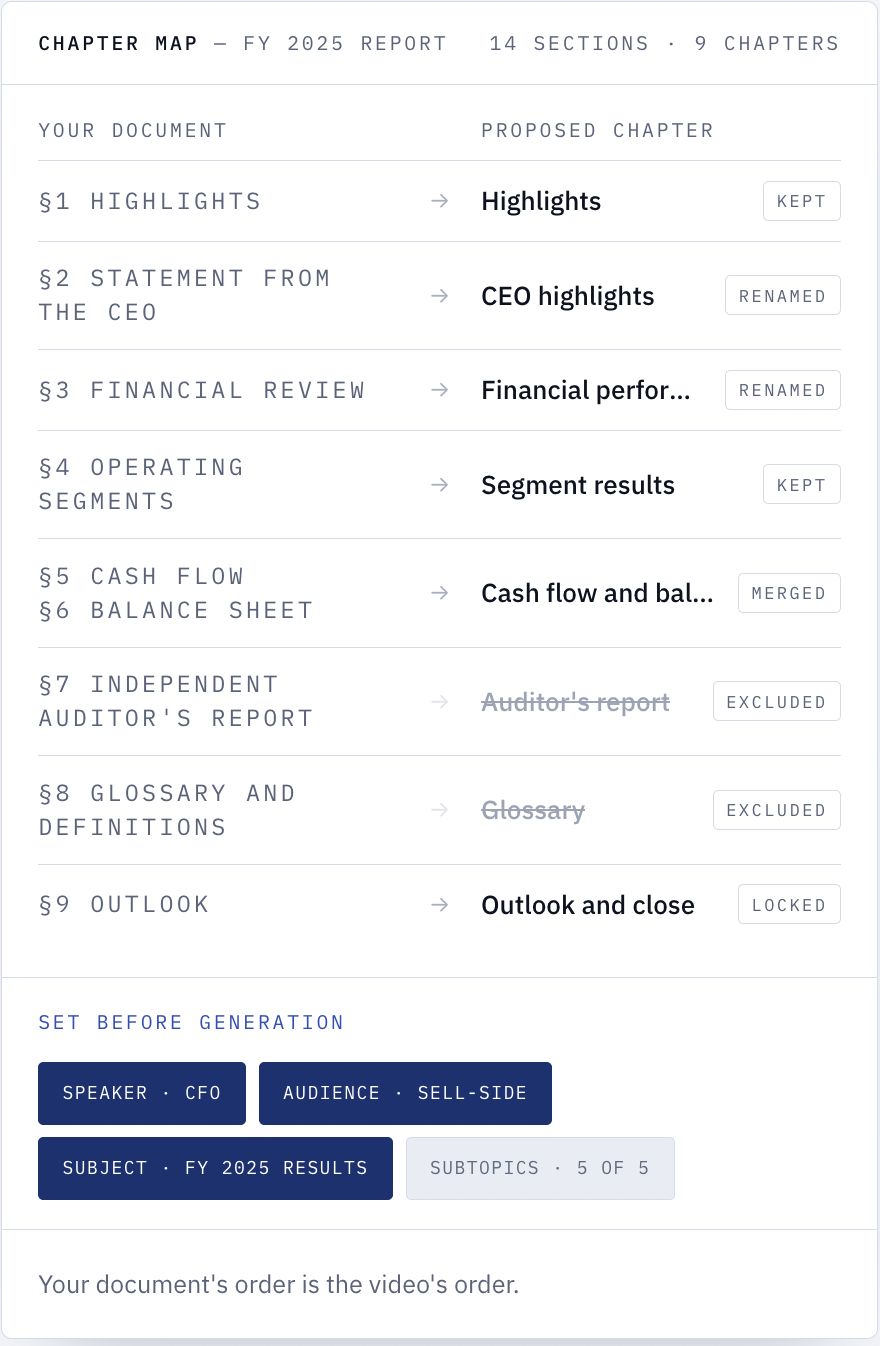
chapter map
HOW IT WORKS

The raw report goes in. It comes out as a "narrated slide deck presentation."

Upload the results PDF —annual report, trading update or press release— and SurgeIR reads it the way a person does: by its headings, its section order, its hierarchy. What comes back is a proposed chapter map of your own document.

"Technology ultimately replaces the parts that technology can effectively replace. And as a result, we have time left for human interaction. For real conversations."

Elke Snijder, CFO, NSI


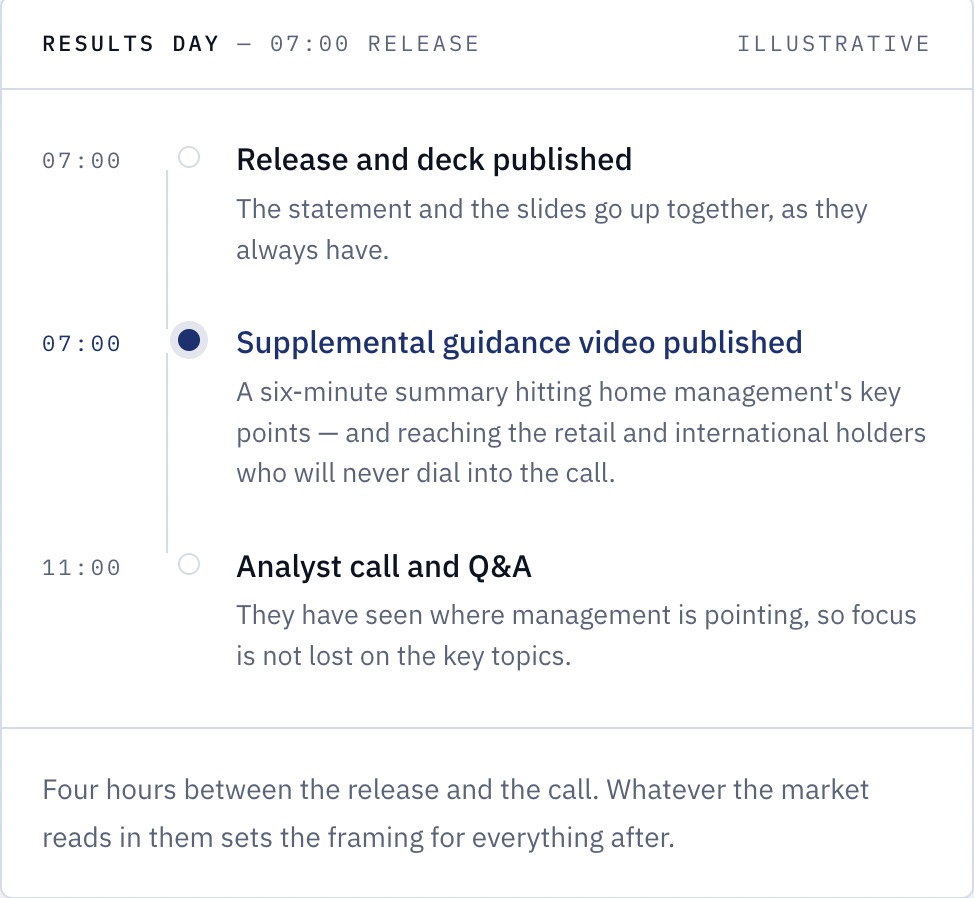
result day
USE CASE 01 • SUPPLEMENTAL GUIDANCE

Investors and analysts would rather watch six minutes than read sixty pages.

The release goes out at seven. The call is at eleven. In those four hours the market forms its first view out of a sixty-page pack, and management has no way to say which part of it the quarter actually turns on.

A supplemental video published with the release closes that gap. A few short minutes, on the record, hitting home management's key points before the first analyst has framed a question — and reaching the holders who were never going to dial in.

Supplemental is the operative word. Nothing is withdrawn and nothing is replaced. This is simply what people watch first, and what they watch first is what they read the rest through.

SUPPLEMENTAL GUIDANCE

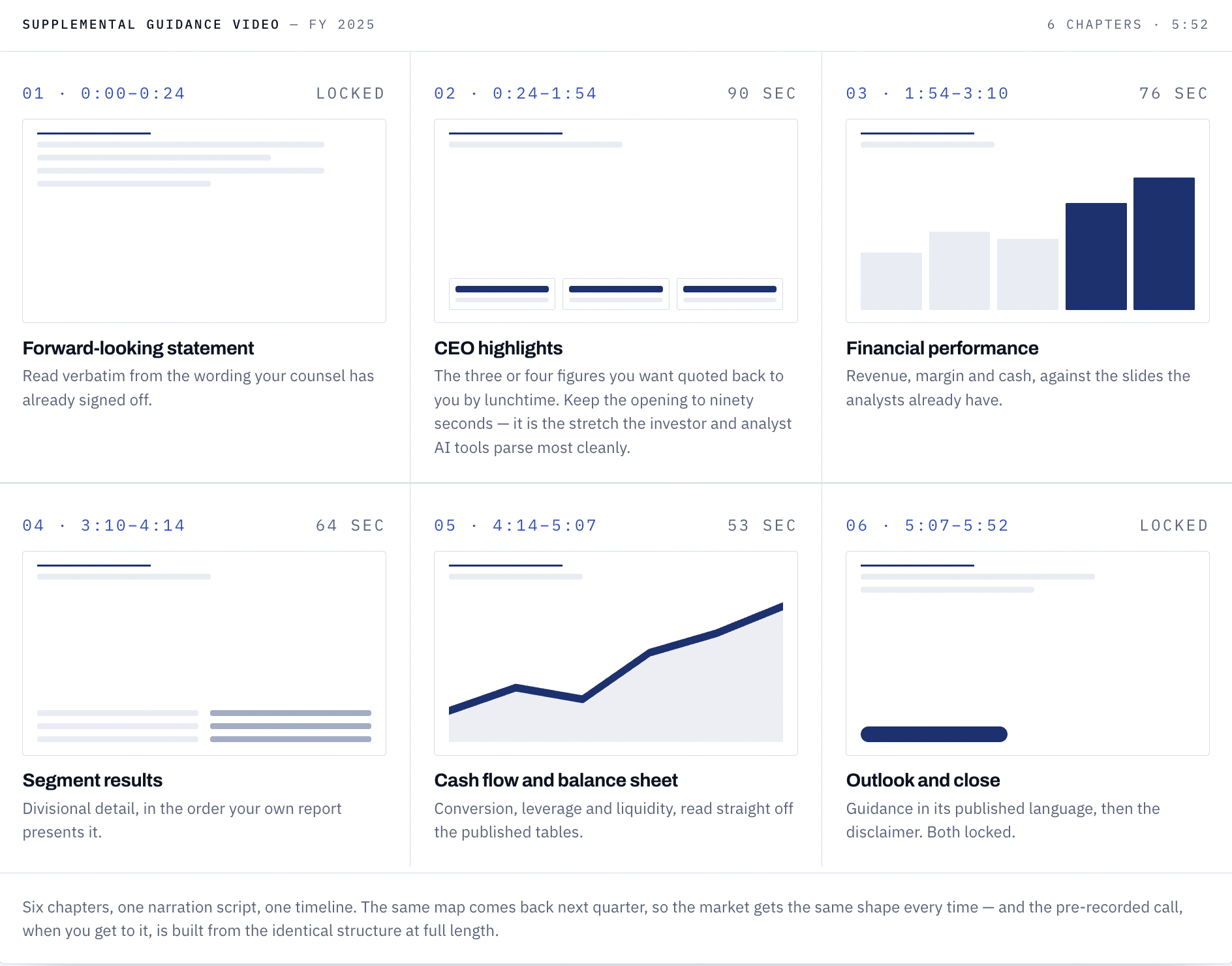
Five minutes fifty, chapter by chapter.

Long enough to carry the quarter, short enough that people reach the end. Chapters carrying required language are locked to your approved text and cannot be edited away by accident.
guidance video
USE CASE 02 • THE PRE-RECORDED EARNINGS CALL

Reading the deck out loud is the least valuable thing a CFO does all quarter.

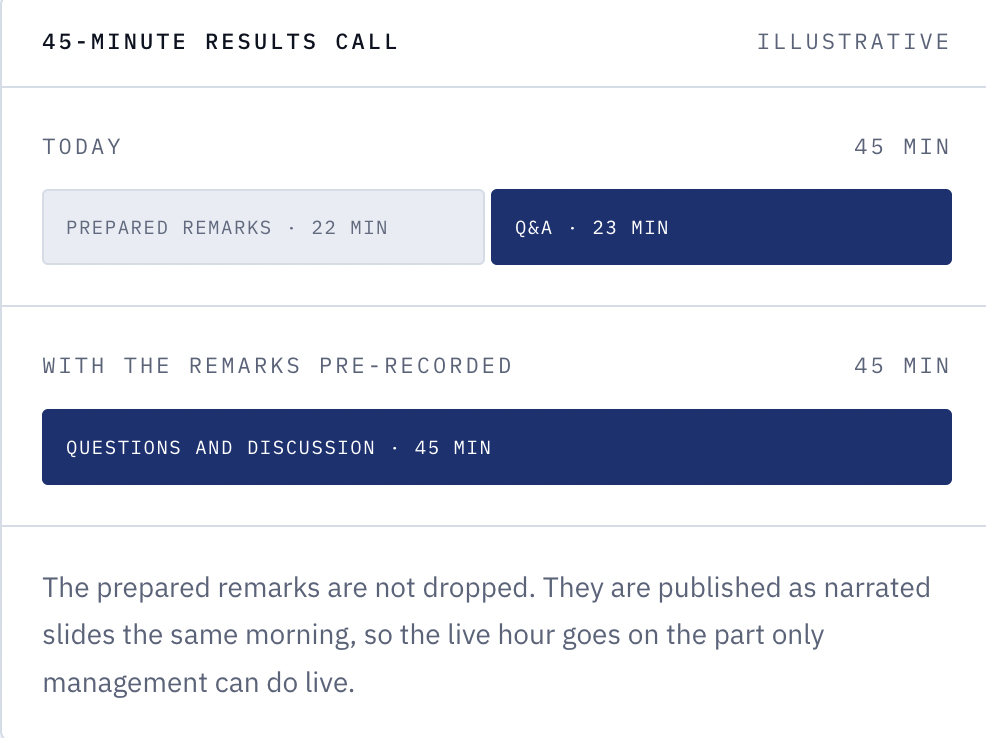
On most results calls the first twenty minutes are prepared remarks: two executives reading a script over slides everyone on the line already has open. It is the part nobody asks a question about, and the part that takes the diary time.

Pre-record it. Publish the prepared remarks as narrated slides with the release, and the live call starts where it should — at the questions. Management joins for the discussion rather than the recital.

It is the same remarks, from the same approved script, checked against the same disclosures and delivered identically in every language your register reads. Nobody stumbles over a segment name on the record, and a correction the night before is a re-render of one chapter.

45 minutes
FREQUENTLY ASKED QUESTIONS

What IR teams ask before the first one.

How long should it be?

Five to six minutes for supplemental guidance, with the opening kept to about ninety seconds. A pre-recorded read-out runs as long as your prepared remarks already do — usually fifteen to twenty-five minutes. The two are different jobs, so do not size one against the other.

Do we need a presenter on screen?

No. Plenty of issuers publish slides and a voice and never put a face in the frame. The presenter is a separate decision, and you can take it a quarter later on the same timeline.

Whose voice is it?

Your CEO's or CFO's, built from one consented recording. Consent is written, use is limited to your own approved material, and it is withdrawn the moment you ask.

What happens when a slide changes?

Replace the slide and re-render the chapter. Charts, key financials and disclaimers update in seconds, and the narration is re-checked against the change rather than left pointing at a number that has moved.

Does it replace the webcast?

No. The call and Q&A stay — that is where the questions are, and the questions are what investors turn up for. But it helps drive the topics management wants to convey and guide the market, leaving no room for alternative framing.

What do you need from us?

The results PDF and the deck, plus recent disclosures to check the script against. If your prepared remarks are already written and signed off, we start from those instead.